
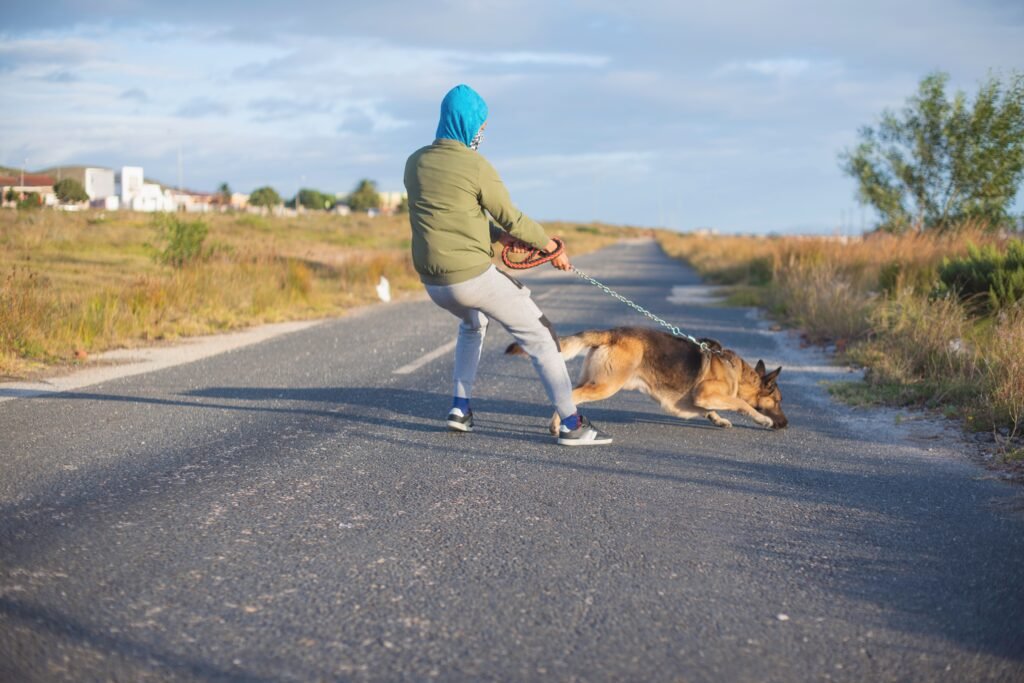
Your dog is not trying to dislocate your shoulder. I know it feels personal.
You grab the leash, you open the door, and suddenly you’re water skiing down the sidewalk behind a furry jet engine.
But here’s the thing most people never get told: your dog pulls because, every single day, pulling works.
And once you understand that one idea, everything about leash training changes.
By the end of this article, you’ll have a simple, step-by-step system that turns chaotic walks into calm ones, plus the one mistake that quietly undoes all your progress.
I’ll get to that mistake near the end, because honestly, almost everyone makes it, even experienced owners.
Why Dogs Pull on Leash
First, let’s talk about why dogs pull in the first place, because you can’t solve a problem you don’t understand.
Dogs naturally move faster than we do.
For a lot of dogs, a comfortable pace is closer to our brisk walk.
On top of that, the outside world is the most exciting thing in their day. Smells, squirrels, other dogs, that one suspicious mailbox.
And then there’s something called the opposition reflex.
When you feel pressure, your instinct is to push back against it. Dogs have the same instinct.
So when the leash tightens and you pull back, your dog’s body naturally leans forward even harder. You’re both pulling, and nobody’s winning.
But here’s the real reason, the one I teased at the start.
Every time your dog pulls toward that tree and you follow, they get to sniff the tree.
Pulling got them what they wanted.
Every time they drag you toward the park and you keep walking, pulling worked again.
Without meaning to, most of us reward pulling dozens of times on every single walk.
So the goal of leash training isn’t to overpower your dog. It’s to change the rules so that a loose leash is the only thing that works.
The Right Leash Training Gear
Before we train, let’s get the gear right, because the wrong equipment can make this way harder.
You want a standard leash, something around six feet long.
Skip the retractable leash for training. It actually teaches your dog that pulling makes the leash longer, which is the exact opposite of what we want.
For the dog’s end, a well-fitted flat collar or a harness works.
If you have a strong puller, a front-clip harness can be really helpful, because when your dog leans forward, it gently turns them sideways instead of letting them power ahead.
Make sure whatever you use fits properly.
You should be able to slide a couple of fingers underneath, but your dog shouldn’t be able to back out of it.
The other piece of gear is the one people forget: really good treats.
Not dry kibble. I’m talking small, soft, smelly rewards your dog would genuinely work for, like tiny bits of cooked chicken or cheese, broken into pea-sized pieces.
Outside, you’re competing with the entire world for your dog’s attention. Your rewards need to be worth more than a squirrel.
Grab a treat pouch or a pocket you don’t mind getting a little gross, because you’ll be handing out a lot of these at first.
Step 1
Okay, step one, and this is where the magic starts. Teach a marker.
A marker is a word or sound that tells your dog, yes, that exact thing you just did earns a treat.
Lots of people use a clicker, but a short word like “Yes” works perfectly.
Inside your house, with zero distractions, say “Yes” and immediately give a treat.
Do that ten or fifteen times. You’re not asking for anything yet.
You’re just teaching your dog that this word means something awesome is coming.
Often within a session or two, you’ll see their ears perk up the moment they hear it. That’s when you know it’s working.
Step 2
Step two. Pick a side, left or right, it doesn’t matter, just be consistent.
Now clip on the leash, still indoors, and just stand there.
The instant your dog comes near that side of your leg, mark it with “Yes” and deliver the treat right next to your leg, at their nose height.
That placement matters more than you’d think.
Wherever the treat lands is where your dog will want to hang out.
If you toss treats out in front, you’re teaching them that out in front is the jackpot zone.
Deliver them right by your pant seam, and that spot becomes their favorite place in the world.
Step 3
Step three. Start walking, but keep it tiny. Take one step.
If your dog stays near you with a loose leash, “Yes,” treat. Take two steps. “Yes,” treat.
Build up slowly, still inside, maybe down a hallway or around your living room.
Right now you should be rewarding a lot, like every few steps.
That might feel excessive, but remember, we’re trying to outcompete possibly years of pulling being rewarded.
As your dog gets it, you’ll slowly stretch out the distance between treats.
Keep these sessions short, around five minutes, and end while your dog is still having fun.
Step 4
Now, step four. This is the big one, the rule change I mentioned.
It’s often called being a tree.
The moment the leash goes tight, you stop. Completely.
You don’t yank, you don’t pull back, you don’t say anything. You just plant your feet and wait.
At some point, your dog will look back at you, or take a step toward you, and the leash will go slack.
The second that happens, mark it, “Yes,” and start walking again. That’s it.
- Tight leash means the walk stops.
- Loose leash means the walk continues.
Your dog doesn’t need to understand English for that to click.
They just need you to be completely, boringly consistent.
I’ll be honest with you. The first few times you try this, it can be painfully slow.
You might go ten feet in five minutes.
Your neighbors might wonder why you’re standing motionless on the sidewalk.
That’s normal, and it’s actually a sign it’s working.
Your dog is figuring out a brand new rule, and that takes time.
Stick with it, because there’s usually a moment, sometimes a few days in, where it suddenly clicks, and your dog starts checking in with you on their own.
That moment is incredibly rewarding.
Step 5
Step five gives you a second tool for when being a tree isn’t enough. Changing direction.
If your dog is charging ahead, cheerfully say something like “Let’s go,” turn around, and walk the other way.
When your dog catches up and is back by your side, mark and reward.
This teaches them that they need to keep an eye on where you’re going, because you might change course at any moment.
It also keeps walks feeling like a game instead of a battle.
Step 6
Step six is where people usually rush, so slow down here.
- Once your dog walks nicely indoors, move to your backyard or driveway.
- Then a quiet street.
- Then a slightly busier one.
Think of distractions like weights at the gym. You don’t start with the heaviest one.
If your dog suddenly falls apart and starts pulling like crazy, that’s not failure.
It just means you jumped a level too fast. Back up to an easier environment, rebuild some success, and then try again.
And here’s a pro tip that makes a huge difference. Use the environment as a reward.
Your dog desperately wants to sniff that patch of grass? Great.
Ask for a few steps of loose leash walking first, then say something like “Go sniff” and let them explore.
Now the very thing that used to cause pulling becomes a reward for not pulling.
Plus, sniffing is mentally enriching for dogs.
A walk with plenty of sniffing can tire them out more than you’d expect, so don’t think of it as wasted time.
The Big Mistake in Leash Training
Okay, now the mistake I promised you at the beginning. The one that quietly undoes all your progress.
It’s inconsistency.
Specifically, having training walks where pulling doesn’t work, and then rushed walks where you just let your dog drag you because you’re late for work.
Every time pulling pays off, even occasionally, your dog learns that it’s worth trying.
And honestly, rewards that only show up sometimes can make a behavior even more stubborn, kind of like a slot machine.
So what do you do on days when you genuinely don’t have time to train?
Use a different setup, like that front-clip harness, as a management tool, or keep those walks very short.
The key is protecting your training so pulling stops being a winning strategy.
Puppy vs Adult Dog Leash Training
A couple of quick notes.
If you have a puppy, start these indoor steps early, keep sessions extra short, and expect a lot of zoomies.
If you’ve got an adult dog who’s been pulling for years, this still works. It just takes more patience, because you’re replacing an old habit, not building a fresh one.
And if your dog lunges, barks, or seems fearful around other dogs or people, that’s a different issue from simple excitement.
In that case, it’s worth reaching out to a qualified trainer or a veterinary behavior professional who can help you safely.
Leash Training Recap
So let’s recap the whole system.
- Get a standard leash and comfortable gear.
- Load up on treats your dog loves.
- Teach your marker word.
- Reward right by your leg.
- Start walking in tiny steps indoors.
- Stop like a tree when the leash goes tight.
- Change direction when your dog charges ahead.
- Add distractions slowly, use sniffing as a reward, and above all, stay consistent.
Key Takeaways
Here’s what I want you to remember. A loose leash isn’t really about control.
It’s about building a conversation between you and your dog, where they learn that paying attention to you always makes good things happen.
Honestly, the walks get calmer, sure, but the bigger change is that your dog starts seeing you as the most interesting thing out there.
Try this consistently for one full week, starting today, and you should start seeing some real progress.