
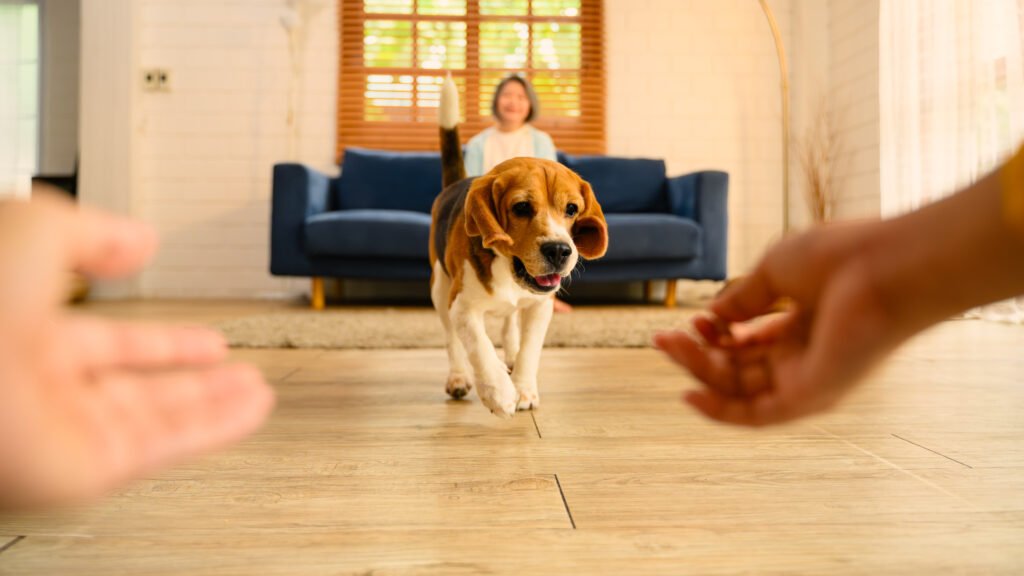
Your dog has perfect recall. In the kitchen. When you’re holding cheese.
But the second there’s a squirrel, a jogger, or another dog across the park, suddenly your voice becomes background noise.
Sound familiar?
Here’s the thing most people never get told: your dog isn’t ignoring you to be stubborn.
Your dog is making a decision.
In that moment, the squirrel is simply a better offer than you are. And the good news is that you can change that math.
By the end of this article, you’ll have a step-by-step system for building a recall that actually works when it matters, plus the one mistake that quietly ruins recall for most dog owners.
I’ll get to that mistake in a few minutes, and trust me, you’ve probably made it.
Why Does Dog Recall Training Matter?
Let’s start with why recall matters so much. A reliable recall isn’t just about convenience.
It’s the command that can stop your dog from running into a road, approaching an aggressive dog, or eating something toxic.
It’s also what gives your dog more freedom, because a dog that comes back can be trusted with more off-leash time.
Step 1: Pick Your Recall Word, and Protect It.
Most people use “Come” or “Here.” That’s fine, but there’s a problem.
If you’ve been yelling “come” for months while your dog ignores you, that word has lost its meaning.
Your dog has literally learned that “come” means “keep doing what you’re doing.”
If that’s you, don’t fight it. Just pick a brand new word.
Something distinct, like “pronto,” “touch,” or even a specific whistle. Whistles work great too, because they sound the same no matter how frustrated you are.
Once you’ve picked your cue, treat it like something precious.
You only say it when you’re confident your dog will respond, at least in the early weeks.
Every time you say it and your dog doesn’t come, the word gets weaker.
Step 2: Make Coming to You the Best Thing in Your Dog’s World.
This is where most recall training lives or dies. Think about it from your dog’s perspective.
Why would they leave a fascinating smell to run back to you? You need to be worth it.
That means using high value rewards, not the dry kibble from their bowl. Think small pieces of chicken, cheese, hot dog, or whatever your dog goes absolutely nuts for.
And don’t just hand over one treat and move on. When your dog comes back, throw a little party.
Praise them, give them several treats in a row, play with them. You want your dog thinking, wow, coming back to my person is incredible.
Step 3: Start Ridiculously Easy.
Begin indoors, in a quiet room, with your dog just a few feet away.
Say your cue word once, in a happy voice, and the moment your dog moves toward you, mark it with a “yes” or a clicker, then reward when they arrive.
That’s it.
Do this 5 or 10 times, then stop while it’s still fun.
A lot of people skip this because it feels too simple.
But right now you’re teaching your dog what the word means, and you’re building a habit.
You want hundreds of successful repetitions before you ever test it in a hard situation.
Now, here’s a game that speeds this up enormously. It’s called ping pong recall.
Grab a family member or friend, stand on opposite sides of a room, and take turns calling the dog back and forth.
Each person rewards when the dog arrives. Dogs love this, and it builds speed and enthusiasm fast.
Another favorite is hide and seek. Hide behind a door or a couch, call your dog, and celebrate big when they find you.
This teaches your dog to actively search for you when they hear the cue, which is exactly what you want outside.
Okay, so I promised you that mistake. Here it is.
The biggest recall killer is calling your dog for something they don’t like.
Calling them in to clip their nails, give a bath, end playtime at the park, or worse, calling them over to scold them.
Even if you’re frustrated because they took forever to come back, if you yell at them when they arrive, you’ve just taught them that coming to you is risky.
Here’s the rule: your dog should never regret coming to you. Ever.
If you need to do something unpleasant, go get your dog instead of calling them. And at the park, don’t only call your dog when it’s time to leave.
Call them, reward them, and then let them go play again. Do that over and over, so the recall doesn’t predict the end of fun.
Step 4: Add Distance and Distractions Slowly.
Once your dog is responding instantly indoors, move to the backyard.
Then a quiet park at an off-peak time.
Every time you change the environment, make it easier again. Get closer, use better treats, and expect your dog to struggle a little. That’s normal.
Dogs don’t generalize well, so a recall that’s perfect in your living room is basically a brand new skill in a field full of smells.
Think of it as two dials: distance and distraction. Only turn up one dial at a time.
If you add a big distraction, shorten the distance. If you increase distance, choose a calm location.
Step 5: Use a Long Line.
A long line is just a lightweight leash, often 15 to 30 feet or more.
It gives your dog the feeling of freedom while making sure they can’t practice ignoring you.
If you call and your dog doesn’t respond, you’re not stuck. You can gently guide them in, or better yet, make yourself interesting by running away, crouching down, or clapping.
Then reward when they get to you.
Pair a long line with a harness rather than a collar, so a sudden stop doesn’t jerk your dog’s neck.
And keep the line loose most of the time, it’s a safety net, not a steering wheel.
The long line stage can last weeks or even months, especially with young dogs, hounds, or breeds that love to chase.
Every successful recall on the line is building the foundation for real off-leash reliability.
Step 6: Practice the Collar Grab.
A recall isn’t finished when your dog runs up to you. It’s finished when you can actually take hold of them.
Plenty of dogs learn to run toward their owner, then dance just out of reach.
So, when your dog arrives, gently touch their collar or harness before you give the treat.
Over time your dog learns that a hand reaching for their collar means good things are coming.
Step 7: Build an Emergency Recall.
This is optional, but I highly recommend it. Pick a second cue, something you’ll only use in a real emergency.
Every time you practice it, give your dog a jackpot, like a whole handful of their absolute favorite food.
Practice it only occasionally, so it stays special.
The idea is that this cue becomes so powerful that your dog reacts almost on reflex, even in a dangerous moment.
Now let’s talk troubleshooting, quickly.
If your dog comes slowly, try running away from them as you call. Most dogs find chasing irresistible.
If your dog only comes when they can see treats, keep rewards hidden in a pouch or pocket, and mix things up, sometimes food, sometimes a toy, sometimes a sniff of that interesting bush.
And if your dog just won’t focus outside, the environment is too hard right now. Step back to somewhere easier. That’s not failure, that’s good training.
And be patient with yourself. Recall is one of the hardest things to teach, because you’re competing with the entire world.
Even well-trained dogs have off days. Keep sessions short, keep them happy, and keep practicing for life, not just for a few weeks.
Quick Recap
- Pick a fresh cue and protect it.
- Make yourself the best thing around.
- Start easy and build slowly.
- Never punish your dog for coming back.
- Use a long line until you’re truly confident.
- And practice the collar grab and an emergency recall.
If you start today, you could see a real difference within a couple of weeks.
Next you might want to check out Dog Obedience Training for Beginners: 5 Essential Commands.