
Your dog is not seven times older than you think.
In fact, if you’ve been using that old multiply-by-seven rule, you’ve probably been getting it wrong for your dog’s entire life.
A one-year-old dog isn’t a seven-year-old kid. Biologically, it’s closer to a teenager.

And a fourteen-year-old Great Dane and a fourteen-year-old Chihuahua?
They’re not even living in the same aging universe.
So today we’re going to break down:
- How dog aging actually works
- Why size changes everything
- Which breeds age the fastest and slowest
And by the end, you’ll be able to figure out your own dog’s age in human years with a lot more accuracy than that old rule ever gave you.
Stick around until the end, because there’s a surprising scientific formula that turns this whole thing upside down.
The Big Myth
Let’s start with the myth.
Nobody knows exactly where the seven-year rule came from.
One popular theory is that someone simply compared average lifespans.
If people lived to around 70 and dogs lived to around 10, divide one by the other and you get roughly seven.
It’s neat, it’s easy to remember, and it’s mostly wrong.
Here’s the problem. Dogs don’t age at a steady pace.
They sprint through their early years and then slow down.
Think about it.
A one-year-old dog can usually reproduce, has most of its adult size, and is full of chaotic teenage energy.
A seven-year-old human child can’t do any of that. So the math falls apart right out of the gate.
So what do veterinarians actually use?
A widely shared guideline, the one you’ll see from groups like the American Veterinary Medical Association, goes something like this.
The first year of a medium-sized dog’s life equals about 15 human years.
The second year adds roughly 9 more, bringing your dog to around 24.
After that, each year counts for about 4 to 5 human years, depending on size.
So a two-year-old dog isn’t 14. It’s a young adult in its mid-twenties.
That explains a lot, right?
That’s why your two-year-old Lab still has the energy of someone who just moved into their first apartment and thinks pizza is a food group.

But here’s where it gets really interesting. That four-to-five-year rule after age two?
It doesn’t apply equally to every dog. And this is the part most people never hear about.
The Dog Paradox
In most of the animal kingdom, bigger animals tend to live longer.
- Elephants outlive mice.
- Whales outlive pretty much everything.
But dogs flip that rule on its head.
Within the dog world, small breeds generally live longer than big ones, sometimes by several years.
A Chihuahua or a Toy Poodle can often reach fifteen years or more.

Meanwhile, giant breeds like Great Danes, Irish Wolfhounds, and Mastiffs often have average lifespans somewhere in the range of seven to ten years.
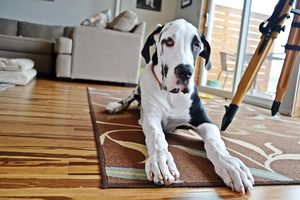
Same species. Wildly different timelines.
Why does this happen?
Scientists are still working on the full answer, but one leading idea is that large dogs grow incredibly fast.
A Great Dane puppy can go from a couple of pounds to well over a hundred in its first year or so.
Some researchers suspect that this rapid growth may take a toll on the body, possibly contributing to earlier onset of age-related problems like cancer and joint disease.
Essentially, big dogs seem to age faster once they hit adulthood.
Here Are The Ages
So let’s put real numbers on it.
Here’s a rough breakdown that many vets use, split into small, medium, large, and giant dogs.
Small Dogs

Small dogs, generally under about twenty pounds, think Yorkies, Dachshunds, and Shih Tzus, age at around four human years per dog year after age two.
So a ten-year-old small dog is roughly 56 in human years.
Middle-aged, maybe slowing down a little, but often still going strong.
Medium Dogs
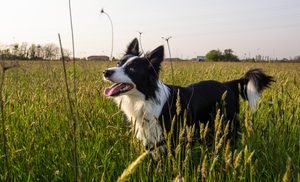
Medium dogs, somewhere between about twenty and fifty pounds, like Beagles, Border Collies, and Cocker Spaniels, tend to land around four to five years per dog year.
A ten-year-old medium dog is somewhere in the mid-fifties to mid-sixties.
Large Dogs
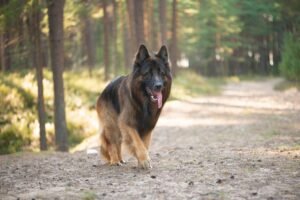
Large dogs, roughly fifty to ninety pounds, think Labradors, German Shepherds, and Golden Retrievers, often age closer to five or six years per dog year once they’re adults.
That same ten-year-old? Now we’re talking mid-sixties to early seventies.
Giant Breeds

And giant breeds, anything over about ninety pounds, can age at six to seven or more human years per dog year.
A ten-year-old Great Dane might be the equivalent of someone in their late seventies or even eighties.
That’s why a giant breed is often considered a senior by the time it’s just five or six years old.
Let that sink in for a second.
Two dogs born on the exact same day could be biologically decades apart by their tenth birthday.
One might be chasing squirrels like a spry retiree, and the other might be struggling to get up the stairs.
Size Isn’t The Only Factor
Now, size is the biggest factor, but it’s not the only one.
Breed matters too, sometimes in ways that break the size pattern.
Take flat-faced breeds like French Bulldogs, English Bulldogs, and Pugs.
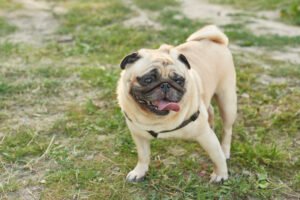
They’re not giant dogs, but they often face breathing problems and other health issues tied to their body shape, and some studies have found they tend to have shorter lifespans than you’d expect for their size.
On the flip side, some breeds are known for being surprisingly long-lived.

Australian Cattle Dogs, for example, have a reputation for toughness, and the dog that’s widely credited as one of the oldest ever recorded, a cattle dog from Australia named Bluey, reportedly lived to twenty-nine years and five months back in the 1930s.
Mixed-breed dogs are another wildcard.
There’s a popular belief that mutts live longer thanks to a bigger genetic mix, and some data does point in that direction, but the effect seems to depend heavily on size and the specific breeds involved.
A mixed-breed giant dog is still a giant dog.
The Surprise
Okay, remember that surprising formula I promised? Here it is.
In 2019, researchers at the University of California San Diego took a completely different approach.
Instead of comparing lifespans, they looked at chemical changes on DNA called methylation, which act like a kind of molecular clock as a body ages.
They studied Labrador Retrievers and compared their patterns to humans.
What they came up with was a formula: multiply the natural logarithm of your dog’s age by sixteen, then add thirty-one.
Don’t worry, you don’t need to do that in your head.
Here’s what it means in practice.
- By that math, a one-year-old Lab is about thirty-one in human years.
- A two-year-old is around forty-two.
- But after that, the aging slows way down.
- A ten-year-old Lab comes out to roughly sixty-eight, and a fourteen-year-old to around seventy-three.
Remember how I said a one-year-old dog is like a teenager?
According to its DNA, it might actually be closer to a thirty-year-old. That’s the twist.
But keep in mind, this study focused on one breed, so it may not apply perfectly to every size or breed.
It’s a fascinating window into aging, not a final answer.
Does This Really Matter?
So why does any of this matter? Because knowing your dog’s real biological age changes how you care for them.
- A dog entering its senior years benefits from more frequent vet checkups, often twice a year instead of once.
- Diet may need adjusting.
- Exercise might shift from long runs to gentler walks.
- Signs of arthritis, dental disease, or cognitive decline are much easier to manage when they’re caught early.
- If you assume your eight-year-old Mastiff is middle-aged, you might miss things that matter.
The Quick Version
Here’s the quick version to remember.
- Year one is about fifteen human years.
- Year two brings your dog to around twenty-four.
- After that, add about four years for small dogs, four to five for medium, five to six for large, and six to seven or more for giants.
And if you want to geek out, plug your dog’s age into that DNA formula and see what you get.
Give your dog an extra treat today. They’re aging faster than you think.