
Your puppy isn’t peeing on the rug to spite you.
It’s actually something way simpler, and once you understand it, potty training gets dramatically easier.
Stick with me, because the fifth tip is the one most new owners get completely wrong, and it’s probably the reason accidents keep happening in your house.
Puppy Bladder Control
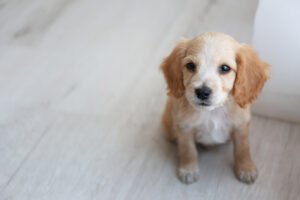
Here’s the truth.
Puppies are born with almost no bladder control, and they have no idea that your house is different from the backyard.
To them, a carpet and a patch of grass feel pretty similar.
So potty training isn’t about teaching a puppy to hold it out of respect for you.
It’s about building a habit, one successful trip at a time, until going outside becomes automatic.
And that’s the mindset shift that changes everything.
Every accident inside is a missed opportunity, and every success outside is a deposit in the habit bank.
Your whole job is to stack the deck so the successes massively outnumber the accidents.
Let’s get into exactly how to do that.
1. The Schedule
Tip number one. Build a schedule and stick to it like glue.
Young puppies need to go out a lot more often than most people expect.
Take your puppy out:
- First thing in the morning
- Last thing at night
- Right after they wake up from a nap
- Right after they finish eating
- Right after they drink a lot of water
- After they wrap up a play session
Those are the big trigger moments.
A common rule of thumb is that a puppy can hold it for roughly one hour per month of age, so a two month old might only manage about two hours.
That’s a loose guideline, not a promise, so lean toward going out too often rather than not often enough.
Feeding on a schedule helps too.
If meals happen at the same times every day, bathroom breaks start becoming more predictable, and predictable is exactly what you want.
2. One Potty Spot Only
Tip number two. Pick one potty spot and always go there.
Carry or lead your puppy to the same patch of yard every single time.
The familiar smell acts like a signal that says, this is where we go.
Keep things boring while you’re there. No playing, no chatting, just stand and wait.
Fun time comes after the job is done, which actually becomes a reward of its own.
3. The Cue Word
Tip number three. Add a cue word.
Right as your puppy starts going, say a short phrase in a calm voice, something like “Go Potty” or “Be Quick.”
Over weeks of repetition, your puppy connects that phrase with the action.
Eventually you can use it to prompt them, which is a lifesaver on rainy nights or before a long car ride.
4. Reward Instantly
Tip number four. Reward instantly, and I mean instantly.
The moment your puppy finishes, praise them like they just won a gold medal and hand over a small, tasty treat.
Timing matters a lot here.
If you wait until you’re back inside to give the treat, your puppy thinks they’re being rewarded for walking through the door, not for peeing outside.
So keep treats in your pocket and celebrate right there on the spot.
5. Never Punish Accidents
Now here’s tip number five, the one I promised, the one that trips up so many owners. Never punish accidents.
I know it’s tempting. You walk in, see the puddle, and you want to make a point.
But scolding, yelling, or the old advice of rubbing a puppy’s nose in it doesn’t teach them to go outside.
What it often teaches them is that peeing in front of you is dangerous.
So they start sneaking off behind the couch or into a back bedroom to go, and suddenly you’ve got hidden accidents all over the house.
Fear makes potty training slower, not faster.
So what do you do instead?
If you catch them mid accident, calmly interrupt with a quick sound, scoop them up, and take them straight to their spot outside.
If they finish there, reward them.
If you find an old accident, just clean it up and move on.
Your puppy won’t connect your frustration to something they did twenty minutes ago.
6. Use The Right Cleaner
Which brings us to tip number six. Clean accidents with an enzymatic cleaner.
Regular household sprays might make the floor smell fine to you, but your puppy’s nose is far more sensitive.
If any scent lingers, it can tell them, hey, this is a bathroom.
Enzyme cleaners are designed to break down the stuff that causes the odor, so the spot stops calling them back.
7. The Crate
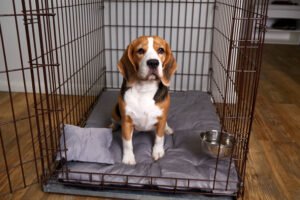
Tip number seven. Use a crate the smart way.
Most dogs naturally avoid soiling the place where they sleep, so a properly sized crate can be a huge help.
It should be big enough for your puppy to stand, turn around, and lie down comfortably, but not so big that they can use one corner as a toilet and sleep in the other.
Make it cozy, never use it as punishment, and don’t leave a young puppy in there longer than they can realistically hold it.
Here is an in-depth Dog Crate Training tuturial.
8. The Warning Signs
Tip number eight. Learn the warning signs and supervise like a hawk.
Sniffing the floor, circling, wandering off, whining, or suddenly stopping play are all classic signals that a puppy needs to go.
When you can’t watch them closely, keep them in a puppy proofed area or in their crate.
Some people even clip a leash to their belt so the puppy stays close.
Setbacks
And finally, expect setbacks. Progress is rarely a straight line.
A puppy who was perfect for a week might suddenly have three accidents in a day, especially after a change in routine, a new home, or a stressful week.
That doesn’t mean you failed. Just tighten the schedule back up for a few days.
If accidents suddenly spike or something seems off, it’s worth checking in with your vet, since health issues can sometimes play a role.
The 3 Keys
Here’s the bottom line.
Potty training comes down to three things:
- Consistency
- Patience
- Rewarding the right behavior at the right moment.
Do those well, and one day you’ll realize your puppy is trotting to the door on their own, and you’ll wonder when it happened.