
Your dog knows what time it is. Not because they can read a clock, but because they’ve been quietly studying you every single day.
The jingle of your keys. The sound of the coffee maker. The way you sigh before you put your shoes on.
And here’s the thing most owners never realize: when those signals are random, your dog lives in a constant state of guessing.
Guessing creates stress.
Stress creates the chewing, the barking, the pacing, the accidents you keep blaming on bad behavior.
So today I’m going to walk you through exactly how to build a daily routine your dog can actually count on.
Morning, midday, evening, and night.
We’ll cover:
- The 5 anchor points every good routine needs
- The one mistake that quietly undoes all your hard work
- The simple trick for handling the days when life falls apart and the schedule goes out the window.
Stick around for that last part, because that’s where most routines fail.
Why Routine Matters For Dogs
First, let’s talk about why routine matters so much to dogs in the first place.
Dogs are creatures of pattern.
In a world where they don’t control when they eat, when they go outside, or when you leave and come back, predictability is one of the few ways they can feel safe.
When a dog knows that a walk follows breakfast and a nap follows the walk, they stop scanning the room for clues.
They relax.
Many trainers and vets point out that a consistent schedule can help with house training, anxiety, and even digestion.
A predictable dog is usually a calmer dog.
But here’s the twist.
Routine doesn’t mean doing everything at the exact same minute every day. That’s a trap, and I’ll explain why later.
What your dog really needs is a predictable sequence. The order of events matters more than the clock.
Keep that idea in your back pocket, because everything we build today is based on it.
Anchor Point #1: The Morning Potty Break
This is the first thing that should happen when your dog wakes up, before coffee, before email, before anything.
Your dog has been holding it all night, and getting them outside right away sets the tone for the entire day.
Use the same door, head to the same spot, and use the same short cue word every time, something like go potty or be quick.
Over time, that phrase becomes a signal your dog understands, which is incredibly handy when you’re in a rush or traveling.
Anchor Point #2: Meals
Most adult dogs do well with 2 meals a day, roughly morning and evening, while puppies usually need more frequent feedings.
Your vet can tell you what’s right for your dog’s age, size, and health. The key is consistency.
Feed in the same place, in the same bowl, and in roughly the same window of time.
And here’s a small habit with a big payoff: ask your dog for a simple behavior before the bowl goes down.
A sit, a down, a moment of eye contact. That turns every meal into a tiny training session and teaches your dog that calm behavior makes good things happen.
One more thing on meals.
Try to give your dog some downtime after eating before any intense running or rough play.
Many vets recommend this, especially for larger, deep-chested breeds. A calm walk later is fine. A wild game of fetch right after dinner is not the best idea.
Anchor Point #3: Exercise
This is where routines vary the most, because a young working breed and a senior lap dog have completely different needs.
A border collie might need serious daily activity to stay sane, while an older dog might be happiest with a couple of gentle strolls.
Whatever your dog needs, the goal is to make it reliable.
If your dog knows a walk is coming every morning, they’re far less likely to bounce off the walls while you’re trying to get ready.
And don’t forget the brain. Physical exercise is only half the picture.
Sniffing, puzzle toys, short training games, a snuffle mat, even letting your dog take their time exploring smells on a walk, all of that counts as mental exercise.
A lot of owners are surprised to find that a short session of sniffing and problem solving can tire a dog out in a way that a fast walk doesn’t.
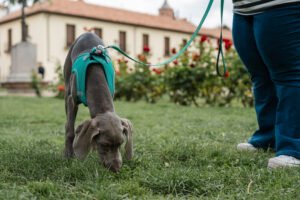
Build at least one mental activity into every day.
Anchor Point #4: Rest

This one gets ignored constantly.
Adult dogs spend a huge portion of their day sleeping, and puppies need even more.
A dog that never gets real downtime can become overtired, and an overtired dog often looks like a hyper, mouthy, misbehaving dog.
Give your dog a quiet spot, like a crate or a bed in a low-traffic corner, and build in calm time after walks and meals.
Rest isn’t wasted time. It’s part of the routine.
Anchor Point #5: The Wind-Down
About an hour before bed, start lowering the energy in your house.
A slow, sniffy stroll, a chew or a gentle cuddle, lights dimming.
Then the same final ritual every night.
Maybe it’s one last trip outside, a small treat in the crate, and a simple goodnight.
Your dog will start to recognize that sequence, and bedtime battles tend to fade.
Sample Daily Routine
Now let’s put it together. Here’s what a sample day might look like for an adult dog with a working owner:
- Wake up, straight outside for a potty break.
- Short walk with plenty of sniffing.
- Come home, ask for a sit, serve breakfast.
- Quiet time while you get ready.
- Before you leave, a puzzle toy or a stuffed chew to keep them busy.
- Midday, if possible, a potty break, whether that’s you coming home, a neighbor, or a dog walker. Evening, a longer walk or play session.
- Then dinner, then relaxation.
- Finally, the wind-down, last potty trip, and bed.
Notice what’s happening there. Every activity is a cue for the next one.
Potty leads to walk. Walk leads to food. Food leads to rest. Your dog doesn’t need a watch. They just follow the chain.
The Big Mistake
Okay, remember that trap I mentioned? Here’s the mistake that undoes everything. Being too rigid.
If you feed your dog at exactly six o’clock every single day, down to the minute, some dogs start demanding it.
They’ll whine, bark, or stare you down at five fifty-nine. And the day you’re stuck in traffic, their whole world feels wrong.
The fix is simple.
Keep the sequence steady, but let the timing float within a window, maybe thirty minutes to an hour either way.
Your dog stays confident about what happens next without panicking over when.
When You Can’t Keep The Routine
And that brings us to the part I promised at the start. What do you do when life blows up the schedule?
A late night at work, a holiday, a move, a new baby, a trip.
This is where most routines collapse, because owners assume it’s all or nothing. It isn’t.
The trick is to protect what I call your non-negotiables.
Pick two or three anchors that happen no matter what.
For most dogs, that’s the morning potty break, meals in roughly the usual order, and the bedtime ritual.
Even if the walk gets shortened and playtime disappears, those familiar bookends tell your dog the day still makes sense.
If someone else is caring for your dog, write those anchors down.
A sticky note on the fridge with the cue words, feeding amounts, and bedtime steps can make a pet sitter’s job so much easier and keep your dog grounded while you’re away.
Give It Time
Some dogs settle into a new routine fast, while rescues or anxious dogs may need a lot longer.
Be patient.
And if you notice sudden changes in appetite, sleep, or bathroom habits, check in with your vet, because sometimes what looks like a routine problem is actually a health issue in disguise.
Here’s what I want you to do today. Grab a piece of paper and write down your dog’s current day, honestly, from wake up to bedtime.
Then circle the 5 anchors.
Which ones are solid? Which ones are chaos? Fix one at a time.
Drop a comment below and tell us which anchor your dog struggles with most and how you overcome it.
Visit our best dog training page to get more tips you can use today!