
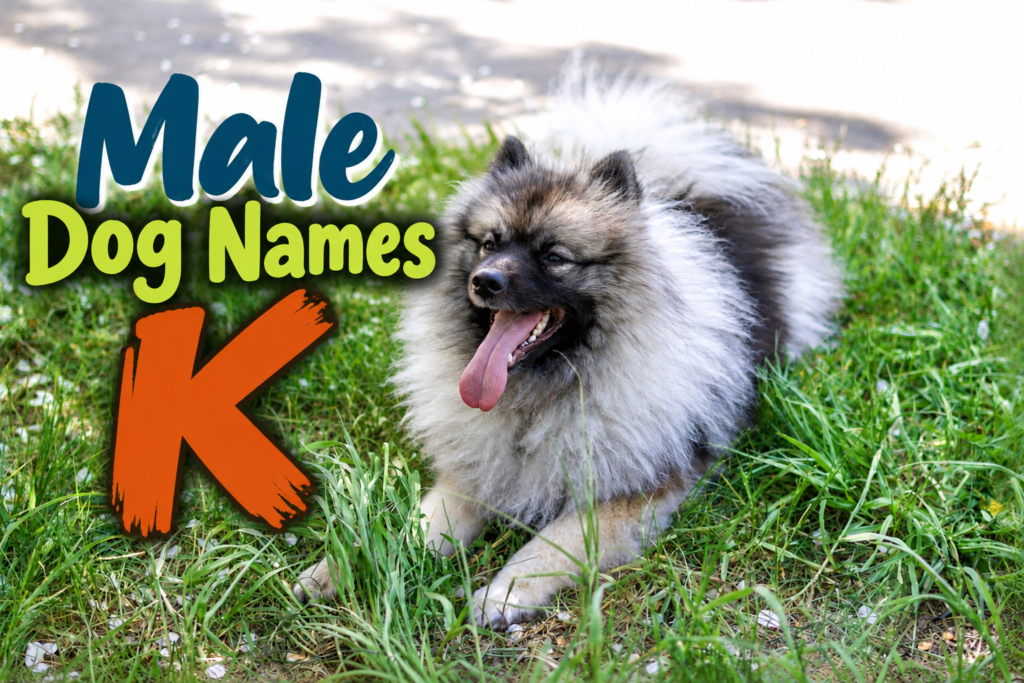
You have 100 appealing male dog names beginning with K, including Kai (“sea” in Hawaiian), Kaiser (“emperor” in German), and Knox (“round hill”).
Koda brings a friendly Disney association, while King gives your boy a royal title with a little humor.
Your favorite name should feel good to say and carry a meaning or association you enjoy.
A Japanese name’s meaning depends on its written characters; a literary surname gets its appeal from its namesake. Those distinctions help you choose with confidence.
- Kai – You get a beach-friendly choice with Kai, pronounced “kye,” meaning “sea” in Hawaiian. Try it for your water-loving puppy.
- Koda – With Koda, your clearest reference is the bear cub in Brother Bear. Treat the widely repeated “Sioux for friend” translation cautiously.
- King – King gives your dog the English title for a male monarch. Its royal meaning works especially well with your little couch enthusiast.
- Knox – Your outdoorsy boy might wear Knox well: this Scottish surname comes from a word meaning “round hill.” The initial K is silent.
- Kobe – If you admire Kobe Bryant, Kobe gives your dog a basketball namesake. Pronounce it “KOH-bee”; the athlete’s name references Japanese Kobe beef.
- Kaiser – You give your dog an imperial title with Kaiser, the German word for “emperor.” Say it “KYE-zer” for that familiar German pronunciation.
- Kane – Through its Irish surname roots, Kane connects your dog with “battle.” Hawaiian Kāne has a separate meaning, “man,” and a different pronunciation.
- Kylo – Your Star Wars inspiration is clear with Kylo, after Kylo Ren. Say “KYE-loh” if you like a dramatic name for your expressive boy.
- Koa – Koa means “warrior” in Hawaiian and names a native Hawaiian tree. You get a compact nature name with a substantial cultural background.
- Kenzo – For your sturdy puppy, Kenzo offers Japanese associations with health or strength in certain spellings. Your chosen kanji determine the precise meaning.
- Krypto – Your comic-book namesake is Superman’s superpowered dog, Krypto. Pronounced “KRIP-toh,” it brings a canine connection to your superhero-inspired shortlist.
- Kipper – Kipper names a split, smoked herring and a children’s-book dog. You get a cheerful choice with both food and storybook associations.
- Kevin – You give your dog an Irish-rooted human name with Kevin, traditionally interpreted as “handsome birth.” Its everyday familiarity adds to the charm.
- Kirby – Kirby’s surname meaning is “church settlement,” while your playful namesake option is Nintendo’s round pink character. Try it for your enthusiastic snack-seeker.
- Klaus – Your dignified boy gets “victory of the people” through Klaus, a German short form of Nicholas. Pronounce it “klows,” rhyming with “house.”
- Kairo – With Kairo, you get a modern spelling associated with Cairo. The Egyptian capital’s Arabic name means “the victorious,” giving your choice a geographic connection.
- Keanu – Keanu means “the coolness” in Hawaiian, commonly rendered as “cool breeze.” You also have actor Keanu Reeves as a recognizable namesake.
- Kenobi – Your inspiration is Jedi Obi-Wan Kenobi from Star Wars. “Keh-NOH-bee” gives you a distinctive full name, with Obi available for everyday use.
- Kodiak – Kodiak connects your dog with Alaska’s Kodiak Island and its bears. For your thick-coated boy, the bear association supplies plenty of character.
- Kovu – You get both a Disney association and a literal meaning: Kovu is a Lion King II character whose name means “scar” in Swahili.
- Kaito – Kaito, pronounced “KYE-toh,” offers your puppy a Japanese name whose possible character combinations include “sea” and “soar.” Check your intended written form.
- Kash – Your money-themed choice is Kash, a modern spelling of cash. Its appeal comes from the familiar English word and punchy sound.
- Kade – Kade gives your dog a modern form of Cade, a surname with several proposed origins. Choose it for its sound without assigning one translation.
- Kaleb – With Kaleb, you choose a spelling of Hebrew Caleb, traditionally connected with “dog.” That gives your boy an especially fitting name association.
- Kieran – Kieran comes from Irish Ciarán, meaning “little dark one.” You might like “KEER-un” for your dark-coated puppy or a boy with dark ears.
- Killian – Your Irish-rooted option Killian comes from Cillian, commonly linked to “little church.” Say “KIL-ee-un,” with Killy available as a household nickname.
- Keegan – Keegan comes from an Irish surname meaning “descendant of Aodhagán,” whose name contains the element for “fire.” Consider it for your lively boy.
- Keith – You get a Scottish place-name connection with Keith, associated with “wood” or “forest.” Its single syllable suits your preference for an understated name.
- Kent – Kent connects your dog with the English county; its ancient name has an uncertain meaning. Clark Kent gives you another familiar namesake.
- Kurt – Your straightforward choice Kurt is a German short form of Konrad, meaning “bold counsel.” It has a crisp, grown-up sound.
- Kirk – Kirk means “church” in Scots and northern English usage. If you enjoy Star Trek, your dog also gets Captain Kirk’s spacefaring association.
- Karl – You give your boy a Germanic classic with Karl, meaning “man” or “free man.” The spelling pairs naturally with your preference for traditional names.
- Kenny – Kenny gives your dog an approachable short form of Kenneth, whose separate Gaelic roots are associated with “handsome” and “born of fire.”
- Kendrick – Your music-inspired namesake is Kendrick Lamar. The surname has several proposed roots, so use that personal association without committing to one literal meaning.
- Kepler – Kepler connects your curious dog with astronomer Johannes Kepler, known for his laws of planetary motion. Say “KEP-ler” for your science-inspired choice.
- Kelvin – You get a science connection through the kelvin temperature unit, named for Lord Kelvin. His title came from Scotland’s River Kelvin.
- Kipling – Your literary namesake is Rudyard Kipling, author of The Jungle Book. Kip gives you a convenient everyday version of this surname choice.
- Kafka – Kafka brings your dog a literary association with Franz Kafka. The surname connects with Czech kavka, meaning “jackdaw,” adding a bird connection.
- Keats – Keats gives your dog a namesake in English poet John Keats. Try this single-syllable surname if your reading tastes lean toward poetry.
- Kerouac – Your literary reference is Jack Kerouac, author of On the Road. Say “KEH-roo-ak” and consider whether you enjoy calling the full surname.
- Kip – Kip means a nap in British informal usage, giving your sleepy puppy an apt word-name. It also works as your nickname for Kipling.
- Kermit – Your most recognizable namesake is Kermit the Frog. The familiar Muppet connection gives your dog a warm, slightly offbeat human name.
- Kronk – Kronk brings your dog the good-hearted character from The Emperor’s New Groove. You might enjoy the association for your big, agreeable companion.
- Kuzco – Your Disney reference is Emperor Kuzco from The Emperor’s New Groove. Pronounced “KOOZ-koh,” it suits your taste for a theatrical character name.
- Kristoff – Kristoff connects your dog with the ice harvester in Frozen. As a form of Christopher, it carries the meaning “Christ-bearer.”
- Khal – You borrow a fictional leadership title with Khal, used among the Dothraki in Game of Thrones. Say “kal” for your fantasy-inspired name.
- Khan – Khan is a historical title meaning “ruler” or “leader” across several Central Asian traditions. You get a compact name with a substantial background.
- Kratos – Your mythology connection is Greek kratos, meaning “strength” or “power.” The God of War character adds a recognizable gaming namesake.
- Kronos – Kronos names a Titan in Greek mythology and the father of Zeus. You get a mythological choice pronounced “KROH-nos.”
- Kraken – The Kraken is a legendary sea monster from Scandinavian folklore. You might enjoy the oversized association for your small dog with an expansive personality.
- Knight – Knight gives your dog the English word for a titled warrior. Remember the silent K when you test its “nite” pronunciation aloud.
- Kevlar – Your material-inspired name is Kevlar, the trademarked fiber associated with protective equipment. “KEV-lar” has a sturdy sound without requiring a mythological backstory.
- Kenai – Kenai connects your dog with Alaska’s Kenai Peninsula and a Brother Bear character. Use “KEE-nye” for your outdoors-inspired choice.
- Klondike – Your northern namesake is the Klondike region of Canada’s Yukon, associated with the gold rush. It gives your adventure-loving dog a geographic connection.
- Kilimanjaro – Kilimanjaro names Tanzania’s famous mountain, giving your dog a grand geographic namesake. Kili offers you a manageable daily nickname.
- Karoo – You get a South African landscape name with Karoo, derived from a Khoekhoe term associated with dryness. Pronounce your choice “kuh-ROO.”
- Kalahari – Kalahari connects your dog with southern Africa’s desert region. Its name derives from a Setswana term associated with great thirst.
- Kona – Kona means “leeward” in Hawaiian and names a district on Hawaiʻi Island. You might choose it to remember your time on the coast.
- Kauai – Your geographic inspiration is the Hawaiian island Kauaʻi. Its name’s origin is uncertain; say “kow-EYE” when testing it for your dog.
- Kyoto – Kyoto means “capital city” in Japanese and names Japan’s former imperial capital. You get a place-inspired choice pronounced “KYOH-toh.”
- Kilkenny – Kilkenny comes from Irish Cill Chainnigh, meaning “church of Cainnech.” You get an Irish city namesake with Kenny as an easy nickname.
- Kashmir – Kashmir connects your dog with the Himalayan region and the origin of the word cashmere. You might like that association for your soft-coated boy.
- Kirin – Kirin names a mythological creature in Japanese tradition and means “giraffe” in modern Japanese. Say “KEE-rin” for your animal-inspired choice.
- Kestrel – A kestrel is a small falcon, giving your quick-moving dog a bird namesake. Kess offers you a shorter option at home.
- Kiwi – Kiwi gives your dog a connection to New Zealand’s flightless bird or the fuzzy fruit. Choose whichever association feels closer to your boy.
- Koala – Your animal namesake is Australia’s tree-dwelling marsupial. Koala has a rounded, gentle sound you might enjoy for your cuddly dog.
- Kudu – Kudu names an African antelope known for its spiral horns. You get an animal-inspired choice pronounced “KOO-doo” for your long-legged boy.
- Koi – Koi refers to carp in Japanese, including the ornamental fish familiar from garden ponds. Try it if your naming tastes favor aquatic connections.
- Krill – Krill names the tiny marine crustaceans eaten by many ocean animals. You get an unusual single-syllable option with a playful small-creature association.
- Kelp – Kelp refers to large brown seaweeds, giving your beach companion a marine nature name. Its short spelling also fits neatly on your dog’s tag.
- Kale – Your vegetable-inspired option is Kale, after the leafy green. Pronounce it “kayl” if you enjoy an everyday food word as your dog’s name.
- Kumquat – Kumquat names a small citrus fruit with an edible peel. You get a pleasantly unexpected food name pronounced “KUM-kwot.”
- Kimchi – Your food namesake is Korea’s seasoned, fermented vegetable dish. Say “KIM-chee” if you like a familiar culinary name with a lively rhythm.
- Kefir – Kefir names a fermented milk drink. English pronunciations vary, so choose “kuh-FEER” or “KEE-fur” and keep your household’s version consistent.
- Kibble – Kibble means dry food pellets, giving your dog a name drawn from his own dinner bowl. It suits your appetite for gentle naming humor.
- Kernel – Kernel means a seed’s inner part or a central component. You also get a computing connection through the core of an operating system.
- Kahlua – Your drink-inspired namesake is Kahlúa, the coffee liqueur. “Kah-LOO-ah” offers a flowing sound; keep the alcoholic namesake away from your dog.
- Kirsch – Kirsch names a cherry brandy and comes from the German word for “cherry.” You get a compact culinary choice pronounced “keer sh.”
- Kool-Aid – Kool-Aid gives your dog a recognizable powdered-drink brand namesake. Expect to spell out the hyphen when you register his name.
- Knish – Your food reference is a filled pastry associated with Ashkenazi Jewish cuisine. Pronounce Knish “kuh-NISH,” including the initial K sound.
- Kugel – Kugel names a baked dish in Ashkenazi Jewish cooking, with noodle and potato versions. Say “KOO-gul” for your comfort-food-inspired choice.
- Kolache – Your bakery namesake comes from Czech pastry traditions. Kolache is commonly pronounced “kuh-LAH-chee” in American English, with regional differences in fillings.
- Kabob – Kabob refers to skewered pieces of food, giving your dog a cookout-inspired name. You also have Kebab as an alternative spelling.
- Kung Pao – Your culinary namesake is the Sichuan-style dish associated with the Chinese title gongbao, or “palace guardian.” The two-word name has a bouncy rhythm.
- Kael – If you choose Kael as a spelling of Irish Cáel, its meaning is “slender.” Pronounce your version “kayl” for a sleek-sounding name.
- Kanan – Kanan gives your dog a Star Wars Rebels namesake in Jedi Kanan Jarrus. The character’s name is pronounced “KAY-nun.”
- Kanoa – Kanoa means “the free one” in Hawaiian. Say “kah-NOH-ah” if you like a flowing name for your companion.
- Kenta – Your Japanese option Kenta includes spellings associated with health and strength. Pronounce it “KEN-tah,” and check the kanji before selecting a precise meaning.
- Kenshin – Kenshin gives your dog a Japanese name whose meaning follows its kanji. Your recognizable fictional namesake is Himura Kenshin from Rurouni Kenshin.
- Kazuo – Kazuo offers your dog a Japanese name with possible meanings including “harmonious man,” depending on the characters. Say “kah-zoo-oh.”
- Kazuki – Your choice Kazuki has several Japanese spellings, including combinations associated with harmony and hope. Confirm the intended characters; pronounce it “kah-zoo-kee.”
- Koji – Koji gives your dog a Japanese given name with character-dependent meanings. You also get a culinary association with kōji, used in fermentation.
- Kofi – Kofi is an Akan male day name meaning “born on Friday.” You might choose it to mark your boy’s birthday.
- Kwame – Your Saturday-born boy has a fitting option in Kwame, an Akan male day name meaning “born on Saturday.” Say “KWAH-meh.”
- Kgosi – Kgosi means “chief” or “king” in Setswana. Before choosing it for your dog, listen to a fluent speaker pronounce the initial consonant.
- Kito – Kito means “jewel” in Swahili, giving your much-loved boy a warm word-name. Pronounce it “KEE-toh” when trying it aloud.
- Kasim – As a spelling of Arabic Qasim, Kasim means “one who distributes” or “sharer.” You get a human name with a generous association.
- Kavi – Kavi means “poet” in Sanskrit. Say “KUH-vee,” keeping both vowels short, if you like a literary meaning for your observant companion.
- Kush – Kush connects your dog with the ancient Kingdom of Kush in Nubia. Choose it for that historical association after considering its modern cannabis meaning.
- Kahuna – Kahuna means an expert or specialist in Hawaiian, including religious practitioners. Consider that cultural significance carefully before using it for your dog.
How to Choose a K Name for Your Male Dog
Choose a name you enjoy saying clearly in everyday situations.
Your shortlist becomes easier to narrow when you test the full name alongside the words your household already uses.
Is the Name Comfortable to Call Out Loud?
Say each candidate at your normal speaking volume, then try calling it across a room.
Include a friendly greeting and a pretend introduction at the vet’s office.
Notice whether you stumble over the pronunciation or feel uncomfortable saying it in public.
Ask everyone who will care for your dog to try the name.
If your household keeps producing different versions, agree on one pronunciation before you begin using it consistently.
Could It Be Confused with a Command or Another Pet’s Name?
Compare your favorites with your actual training cues, including words used in another language.
Listen for similar vowel sounds and endings; Koa and “no,” for example, deserve an aloud comparison. Say existing pets’ names beside each candidate as well.
Give each pet a name you can distinguish easily when speaking quickly. Your accent and chosen commands are the useful test here.
A printed spelling tells you less about potential confusion than hearing the words together.
Would a Short Everyday Nickname Help?
A nickname helps you use a long name comfortably during walks and daily routines. Try Kilimanjaro with Kili, Kipling with Kip, or Kenobi with Obi.
Choose a shortened form you enjoy before committing to the longer version.
Keep your first name-training sessions consistent with the version you plan to use most.
Say it warmly, reward your dog when he turns toward you, and practice in a quiet space.
Introduce additional affectionate nicknames once that everyday name is familiar.
Does the Name Still Suit Your Dog as He Grows?
Choose a name you will enjoy using for your adult dog as well as your puppy.
Consider its meaning beyond his current size or coat color, especially if you are adopting a young dog whose appearance will change.
For your rescue dog, ask which name he already knows and how he responds to it. If you choose a new one, pair it with pleasant attention and rewards.
Give yourself time to notice his habits before settling on a personality-based choice.
Understanding Name Meanings and Origins
Separate a name’s literal translation from the person, place, or character you associate with it.
That distinction lets you explain your choice accurately without losing the personal connection that made you like it.
How Do Literal Meanings Differ from Namesake Associations?
A literal meaning comes from a word’s language roots, such as Hawaiian kai, meaning “sea.”
A namesake association comes from your chosen reference, such as astronomer Johannes Kepler.
Both give you a meaningful reason to choose a name.
Describe your choice in those terms when someone asks about it. With Keats, you might explain that you named your dog after the poet.
With Kipper, you might mean the storybook dog, the smoked fish, or both.
Why Can a Name Have Different Meanings Across Languages?
The same English spelling sometimes represents separate names with different histories.
With Kane, your intended Irish connection differs from Hawaiian Kāne. Accent marks and pronunciation help preserve that distinction.
For Japanese names, ask which written characters support the meaning you want.
Kenzo and Kazuki each have multiple possible spellings in kanji, so a single English translation covers only particular forms.
Record the intended spelling alongside your pronunciation if that meaning is central to your choice.
How Can You Check Pronunciation and Cultural Context?
Check an established dictionary for an ordinary word and a language-specific reference for a personal name.
For place names, look for pronunciation recordings from local institutions or speakers. Listen to the full word several times before making your own phonetic note.
For culturally significant choices such as Kahuna or Kgosi, learn how the word functions in its original setting.
A fluent speaker or cultural organization offers useful context about titles and respectful usage.
Choose another candidate if the term’s role feels uncomfortable for a pet name.
Let Us Know
Which of these names are your favorites, and why? Let us know in the comments, including the meaning, namesake, or nickname that helped you choose.